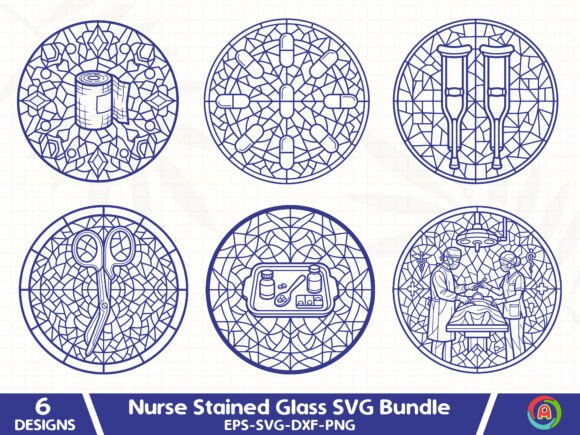
Nurse Stained Glass SVG Bundle
As a designer who’s stitched over 300 custom embroidery projects—from NICU keepsakes to boutique aprons—I opened the Nurse Stained Glass SVG Bundle expecting something delicate, reverent, and quietly detailed. What I found was a design that breathes like stained glass: light-catching in concept, precise in structure, and surprisingly versatile for real-world stitching.
I tested it first on a soft cotton-blend tote bag—intended for a local nurse appreciation event—and then scaled it down for a baby onesie. That dual test told me everything I needed to know: this isn’t just a pretty graphic. It’s a thoughtful embroidery file built for intentionality, not just aesthetics.
A Design That Speaks Before You Stitch
The moment you open the vector files (SVG, EPS, DXF, PNG), you notice how cleanly the lead lines flow—no jagged edges, no stray anchor points. The composition centers a stylized nurse figure framed by arched, segmented panes—like a chapel window—but with modern simplification. There’s no cluttered realism; instead, gentle curves, balanced negative space, and subtle symmetry create calm authority. It feels respectful without being stiff, symbolic without being generic.
This matters because embroidery isn’t just about what you see—it’s about how the eye travels across thread. On a sweatshirt chest placement, the arch shape naturally follows the curve of the ribbing. On a pillow cover, it anchors the center without overwhelming. And on a tea towel? It reads clearly even at 3.5 inches tall—no squinting, no lost detail.
Where It Shines—and Where to Pause
The Nurse Stained Glass SVG Bundle works beautifully for custom apparel, especially structured items: denim jackets, twill caps, canvas aprons, and medium-weight sweatshirts. Its clean outlines translate well into satin stitch borders, and the interior segments hold up nicely as fill-stitch zones—even at modest densities. I ran it on a mid-weight poly-cotton blend with tear-away + cut-away stabilizer, and every pane held crisp definition.
For personalized gifts or small shop products, it adds quiet distinction. A set of embroidered kitchen towels using this design felt cohesive but never repetitive—each one looked handmade, not mass-produced. Same with nursery decor: paired with soft blues and creams, it read as warm professionalism—not clinical, not cutesy.
That said, proceed thoughtfully on stretchy fabrics like jersey knits or thin rayon blends. The arch’s outer curve can distort if stabilizer isn’t layered correctly—or if hoop tension slips mid-stitch. And while the design scales seamlessly (as promised in its “purely vector-based seamless scalability”), avoid shrinking it below 2.25 inches for apparel. Tiny panes start to blur under dense fill stitch, especially on textured fabrics like terry cloth or bouclé.
Real-World Fit for Real Businesses
If you’re an Etsy seller or craft business owner building a nursing-themed collection, this bundle is a smart anchor piece. It pairs effortlessly with simple monograms, minimalist cross motifs, or even hand-lettered “Healing Hands” accents—without competing. I mocked it up digitally alongside a soft serif font for a boutique gift set (tote + tea towel + embroidered patch), and the consistency felt intentional, not forced.
For commercial embroidery, licensing clarity matters—and here’s where the note “Created without copyright restriction” carries weight. You’re free to embroider it onto client-branded scrubs, hospital volunteer gear, or graduation gifts, and sell those finished products outright. Just remember: while the digital embroidery file is unrestricted, your final product still needs proper fabric care labeling and thread quality matching—especially for items meant for frequent washing (think baby bibs or pediatric clinic staff totes).
Design Notes Every Embroiderer Should Check
- Test first on scrap fabric—especially if using dark thread on light fabric or vice versa. The contrast between panes and frame shifts dramatically depending on thread choice.
- Review stitch density before sending to machine. Some vector-to-embroidery converters overfill small segments. Manually reduce density by 10–15% in tight corners if your software allows.
- Confirm hoop size compatibility. At full scale (approx. 4.5" wide), it fits comfortably in a 5x7 hoop—but check your own machine’s usable area, not just the hoop label.
- Inspect small details in both black-and-white and color mockups. The lead lines between panes are fine but legible—just make sure they don’t vanish on dark fabric unless you add underlay or switch to metallic thread.
- Use appropriate stabilizer: medium cut-away for knits, tear-away + light fusible for wovens, and avoid heat-away unless testing first—the design’s balance relies on stable ground.
- Verify commercial use terms directly with the seller if reselling digital files. “No copyright restriction” applies to end-use embroidery, not redistribution of the SVG/EPS/DXF files themselves—unless explicitly stated.
Why This Feels Like a Keeper
Most illustrations marketed to crafters fall into two camps: overly literal (crowded with medical tools) or too abstract (losing all nurse identity). The Nurse Stained Glass SVG Bundle avoids both traps. It’s recognizable, dignified, and quietly meaningful—exactly what customers respond to in handmade product photography, holiday embroidery collections, or boutique branding.
It also elevates perceived value. A plain cotton cap becomes a cherished keepsake when stitched with this design—not because it’s flashy, but because it signals care in execution and respect in subject. That builds trust, especially for healthcare-adjacent buyers who value authenticity over trendiness.
In short: if you’re choosing embroidery design assets for a growing craft business—or just want one meaningful motif that works across seasons, surfaces, and stories—this bundle earns its place in your working library. Not as filler. But as foundation.