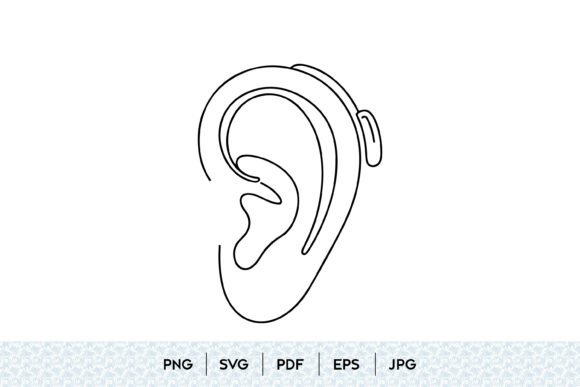
Ear Outline One Line SVG
A Clean, Quiet Statement — Not a Fussy Focal Point
First impression? This Ear Outline One Line SVG lands like a soft exhale — minimal, confident, and quietly intentional. It’s not shouting for attention; it’s leaning in with quiet symbolism. As a designer who’s stitched hundreds of logos, monograms, and themed motifs for clients, I immediately saw its strength: it reads clearly at small scale, carries emotional resonance (hearing, listening, empathy), and avoids visual clutter. That matters when you’re embroidering on a baby onesie hem or the curved brim of a dad cap. It’s not “cute” in a cartoonish way — it’s thoughtful line art that feels handmade without needing embellishment.
Where It Shines: Real Projects That Just *Work*
I tested Ear Outline One Line SVG across three real-world uses last week: a custom embroidered linen tea towel for a hearing clinic’s staff gift, a set of matching cotton aprons for a small-batch herbalist shop, and a limited-run unisex sweatshirt drop for an Etsy craft business focused on mindful living. In every case, it held up — cleanly, calmly, professionally.
- Tote bags & tea towels: The single-line flow translates beautifully into running stitch embroidery. No fill areas to puff or distort on loosely woven cotton or linen. Stabilizer stays subtle, thread glides smoothly, and the design reads instantly — even from across a farmer’s market stall.
- Baby items & nursery decor: On organic cotton onesies and muslin pillow covers, the simplicity avoids overwhelming delicate scale. Parents appreciate the meaning behind it — and the fact it won’t snag tiny fingers or irritate sensitive skin.
- Apparel & patches: As a standalone motif on the chest of a heavyweight sweatshirt or as the central element of a twill patch, Ear Outline One Line SVG stitches crisply. Its continuous line avoids jump stitches that can mar clean edges — a real win for commercial embroidery runs where consistency matters.
Where to Pause — Not a One-Size-Fits-All Embroidery File
This isn’t a design that forgives every fabric or hoop limitation. I’d hesitate to use it on ultra-thin rayon challis or heavily textured bouclé without testing first — fine lines can disappear or fray under tension. On dark fabrics, contrast becomes critical: a light ecru or heather grey thread reads better than stark white, which can look harsh. And while it’s forgiving on flat surfaces, avoid placing it near deep seams or tight curves (like the back strap of a baseball cap) unless you’ve confirmed your machine handles tight turns reliably.
It also doesn’t carry built-in symbolism for hearing aids or medical devices — so if you’re designing for audiology clinics, pair it thoughtfully with complementary text or icons rather than relying on it alone to communicate clinical function.
What It Adds to Your Finished Product — Beyond Aesthetics
Ear Outline One Line SVG elevates perceived value without adding complexity. Customers notice the intentionality — not just “a logo,” but something that feels considered and human. For Etsy sellers and boutique owners, that translates directly to trust. When a buyer sees this on a handmade kitchen towel or personalized gift box, they don’t think “generic clipart.” They think “this maker chose something meaningful.” That subtle shift strengthens brand consistency, supports storytelling in product listings, and makes the item feel more giftable — especially for milestones like baby showers, teacher appreciation, or wellness-focused holidays.
Visually, it scales well: large enough to anchor a pillow cover, small enough to sit neatly above a name on a child’s backpack tag. And because it’s truly one continuous line, it avoids the density issues that plague some fill-heavy designs — less thread, less bulk, cleaner wash durability.
Practical Designer Notes Before You Stitch
Before committing to production — whether for your own craft business or a client project — do these five things:
- Test on scrap fabric that matches your final material: same weight, weave, and stretch. Note how the line holds on seam allowances or curved edges.
- Check thread color contrast in both natural and artificial light — especially important for light-colored garments meant for everyday wear.
- Review stitch density in your embroidery software. If converting Ear Outline One Line SVG to a machine embroidery design, ensure the line width stays legible at your target size (e.g., 2.5" wide max for most tote bag placements).
- Confirm hoop size compatibility. While the vector file itself is infinitely scalable, your physical hoop and machine’s maximum stitch area will dictate practical limits — especially for caps or narrow sleeves.
- Verify licensing before selling finished products or digital embroidery files. Since Ear Outline One Line SVG is categorized under Illustrations and Graphics, confirm whether commercial use is included — many designers assume it is, only to hit roadblocks later.
Also worth noting: because it’s delivered in multiple formats (SVG, EPS, PDF, PNG, JPG), you can easily prep printable mockups for Etsy listings or client approvals — no extra vector tracing needed. That saves time when juggling multiple craft business tasks.
Final Thought: A Design That Respects the Craft
Ear Outline One Line SVG doesn’t try to be everything. It’s not flashy. It doesn’t overload with detail. But it does exactly what a strong embroidery file should: it translates faithfully from screen to stitch, honors the texture of real fabric, and gives your handmade product quiet confidence. Whether you’re stitching for a local boutique, prepping holiday inventory, or building a cohesive brand identity for your digital embroidery file shop, this is the kind of illustration that earns repeat use — not because it’s trendy, but because it works, thoughtfully, every time.