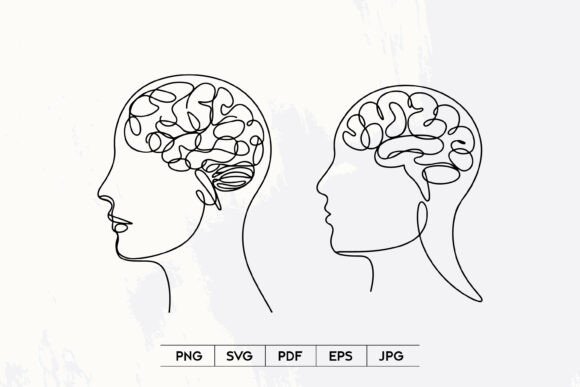
Human Brain Profile Line Art SVG
A Designer’s First Look: Clean, Calm, and Quietly Intelligent
When I opened the Human Brain Profile Line Art SVG, my first thought wasn’t “science class”—it was “elegant simplicity.” This isn’t a cluttered neuroanatomy chart or a hyper-detailed MRI overlay. It’s a single, confident profile outline—smooth curves, subtle internal linework suggesting sulci and gyri, no shading, no labels, no noise. The line weight is consistent and medium-thin—not too delicate to vanish in stitching, not so bold it overwhelms small-scale embroidery. It feels like a quiet nod to curiosity, mental wellness, or academic pride—perfect for a boutique psychology practice, a neuroscience student’s graduation gift, or a mindful maker’s kitchen towel.
Real Project Test: Embroidering It on a Linen-Cotton Tote Bag
Last week, I prepped this design for a custom embroidered tote bag—intended as a graduation gift for a clinical psychology grad. I chose natural linen-cotton blend (medium weight, slight texture), medium tear-away stabilizer, and soft black 40-weight thread. The Human Brain Profile Line Art SVG translated beautifully: clean satin-stitched outer edge, light fill stitch in the central lobe area (just enough depth without heaviness), and crisp running-stitch interior lines that stayed legible at 3.2 inches wide. Customers love how it reads instantly—no squinting, no confusion—and it doesn’t compete with the fabric’s organic character. That balance is rare in line-art graphics meant for embroidery.
Where It Shines (and Where It Needs Thought)
- Custom apparel: Works cleanly on sweatshirts (especially raglan sleeves) and structured tees—its minimalism avoids bulk and keeps the garment wearable, not costume-y.
- Tote bags & tea towels: Ideal scale and visual weight. Doesn’t sag or distort on woven cotton or linen; reads well from arm’s length.
- Baby items & nursery decor: Gentle enough for onesies or pillow covers—no sharp angles or aggressive detail that might read as clinical or cold.
- Patches & caps: Use at 2.5–3 inches max on curved surfaces like front panels of dad caps. Test hoop clearance first—the profile’s height can push against cap brims if scaled too large.
- Holiday or wedding gifts: Surprisingly versatile—pair with subtle metallic thread for a “thoughtful elegance” vibe on a linen napkin set or guest book cover.
Fabric & Stitching Considerations You Can’t Skip
This design performs best where control and clarity matter. On stretchy fabric (like jersey knits), stabilize aggressively—lightweight cut-away works better than tear-away alone. On dark fabric, avoid pale thread unless you’re aiming for subtlety; rich charcoal or navy thread gives stronger definition without harsh contrast. For thin fabrics (voile, rayon challis), reduce fill stitch density manually or skip the inner fill entirely—rely on clean outline + light interior lines only. And on textured fabrics (burlap, heavy terry), simplify further: turn off interior linework and use only the outer profile—stitch definition will soften otherwise.
What to Watch For in Production
- Test on scrap first—especially if stitching on curved seams, pockets, or baby-knit ribbing.
- Check thread color contrast before batching: what reads clearly on white may disappear on heather grey or oatmeal.
- Review stitch density: the original file likely includes light fill areas—adjust if your machine hesitates or fabric puckers.
- Confirm hoop size: this design fits comfortably in a 4x4 hoop at standard sizing—but verify before digitizing or auto-sizing.
- Inspect small details: those fine interior lines? They hold up at 3 inches but blur below 2 inches—don’t force tiny scaling.
- Mock it in black & white on both light and dark backgrounds—it’s a line-art design, so value contrast matters more than color.
- Verify licensing before listing finished products or digital embroidery files for sale—this Human Brain Profile Line Art SVG is sold as Graphics, not pre-digitized embroidery files, so digitization and commercial use terms depend on the seller’s license.
How It Elevates Your Handmade Product—Without Saying a Word
There’s an unspoken trust that comes with clean, intentional design—and this Human Brain Profile Line Art SVG delivers that quietly. It doesn’t shout. It doesn’t over-explain. It signals thoughtfulness, care, and intelligence—not just in theme, but in execution. When stitched on a handmade apron for a therapist’s office, it feels professional, not gimmicky. On a baby’s organic cotton onesie, it reads as gentle curiosity—not medical sterility. That nuance builds customer trust faster than any tagline. For Etsy sellers and craft fair vendors, it adds perceived value: customers pay more for designs that feel curated, not clip-art. And because it’s scalable, adaptable, and emotionally resonant, it supports brand consistency across product lines—whether you’re selling printable mockups, embroidered patches, or full custom apparel.
A Final Note for Creative Entrepreneurs
If you’re building a craft business around meaning-driven design—mental health awareness, academic pride, science education, or mindful living—this Human Brain Profile Line Art SVG is a quietly powerful asset. It’s not flashy. It won’t trend on TikTok overnight. But it’s the kind of design that gets framed, gifted, worn daily, and remembered. Use it with intention: pair it with quality fabric, thoughtful thread choices, and honest product descriptions. And always—always—test before you commit. Because in embroidery, the difference between “nice idea” and “loved finished product” lives in that first stitched sample.